
As part of our ongoing series exploring what long-term cancer survivors say helped them most, one thing becomes clear: when you talk to people who’ve beaten the odds, certain patterns begin to emerge.
Over the years, I’ve interviewed cancer survivors from all over the world. Different cancers. Different protocols. Different doctors.
But one thing keeps coming up:
At some point, they started looking at their environment differently.
Not as background.
But as part of the problem.
They started asking different questions.
Questions they may not have previously thought to ask.
Questions like:
- What’s in my water?
- What am I breathing?
- Is mold hiding in my home?
- What chemicals am I unknowingly putting on my skin?
- What’s in my food?
Because once you’ve faced cancer—or any serious illness—you start to realize something:
Healing isn’t just about attacking disease.
It’s about reducing the burden on the body.
And for many survivors, that burden was toxic overload.
The Bucket Theory of Toxic Load
Think of your body like a bucket.
Every day, that bucket fills.
- Pesticides in food.
- Heavy metals in water.
- Mold spores in the air.
- Chemical cleaners.
- Plastics.
- Fragrances.
- EMFs.
- Stress hormones.
Your body is designed to handle a good portion of it.
But what happens when the bucket overflows?
Inflammation rises.
The immune system gets distracted.
The liver gets overworked.
The lymphatic system slows down.
And the terrain—the internal environment that determines health—begins to shift in the wrong direction.
This is why so many survivors I’ve spoken with became obsessed with reducing what was filling the bucket.
And it makes so much sense.
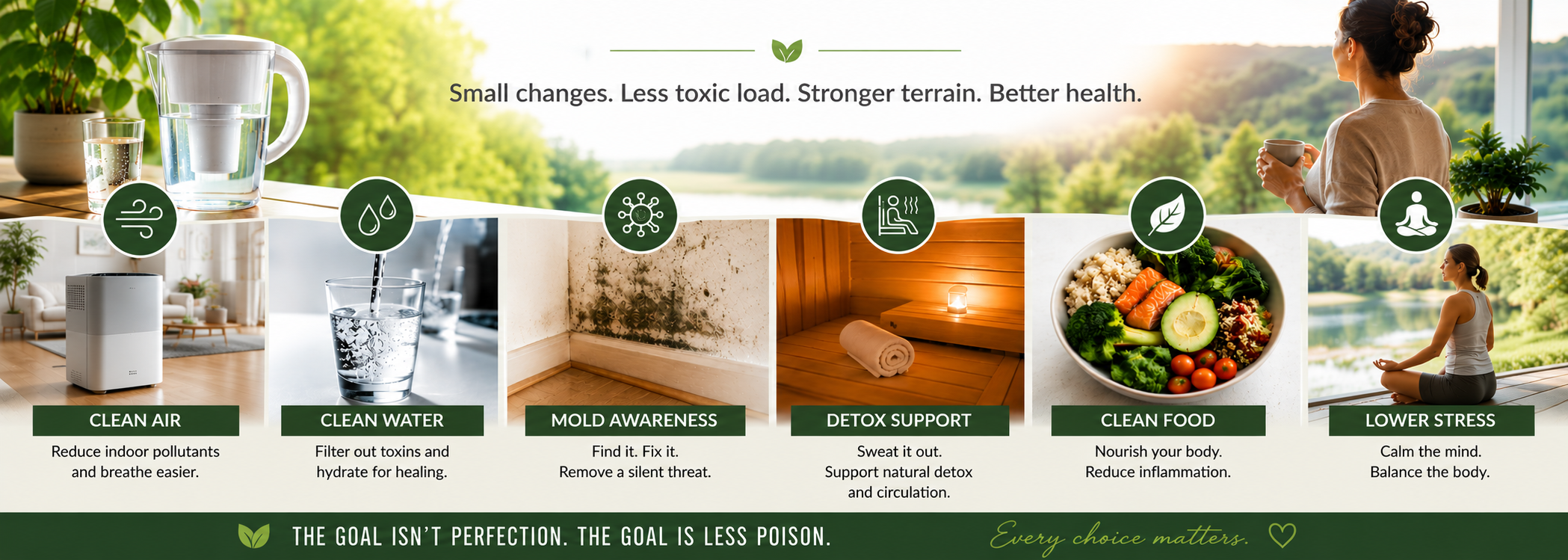
Clean Air: What You Breathe Matters More Than You Think
The average person spends about 90 percent of their time indoors.
And indoor air can be significantly more polluted than outdoor air.
Think about that.
- Dust
- VOCs (Volatile Organic Compounds)
- Mold spores
- Cleaning chemicals
- Off-gassing furniture
- Pesticide drift
For cancer survivors, air quality often becomes a priority.
Many invest in HEPA filtration—not because it’s trendy—but because breathing cleaner air reduces immune stress.
Several survivors I’ve interviewed told me improving their air quality was one of the fastest changes they noticed.
Better sleep.
Less congestion.
Less brain fog.
More energy.
It makes sense that sometimes the simplest healing strategy is cleaner air.
Mold: The Hidden Saboteur
This one is huge.
And often missed.
I know because I experienced it first-hand. (See my article, The Silent Menace of Mold and Its Related Cancer Risk)
Mold toxicity can silently create chronic inflammation, immune dysfunction, neurological symptoms, fatigue, and respiratory stress.
And many survivors discovered mold was a major hidden factor.
Not always visible.
Not always obvious.
Behind walls.
Under sinks.
In HVAC systems.
After water damage.
I’ve heard this story over and over:
“I didn’t start improving until I got out of the mold.”
That’s not something to ignore.
If your body feels stuck—especially after treatment—mold should be investigated.
Water: The Filtered Foundation of Healing
Water seems simple.
Until you realize what’s in it.
- Chlorine.
- Fluoride.
- Pharmaceutical residues.
- Heavy metals.
- PFAS—the “forever chemicals.”
- Microplastics.
- Agricultural runoff.
Cancer survivors often become very intentional about water.
Why?
Because every detox pathway depends on hydration.
Your kidneys.
Your lymphatic system.
Your digestion.
Your sweat.
Your cells.
If the water going in is adding to the toxic burden, you’re working against yourself.
One of the first things many survivors change?
Their water.
Filtered drinking water.
Filtered shower water.
Better hydration.
Less toxic input.
Simple.
Powerful.
Necessary.
See my article, If You Have Cancer, Clean Up Your Drinking Water NOW.
Far Infrared Saunas: Sweating on Purpose
This has been one of my personal staples for years.
And if you’ve followed my work, you know I’m a big believer in far infrared sauna therapy.
Why?
Because sweating is one of the body’s oldest detox tools.
Far infrared saunas help raise core body temperature gently, stimulate circulation, and activate sweating in a way that many survivors say helped them tremendously.
Hyperthermia—using heat therapeutically—has been explored in cancer care for decades, including at major institutions like the National Cancer Institute. Heat stresses abnormal cells, supports circulation, and may support immune activity.
For me, sauna is not just about sweating.
It’s about unloading.
Relaxing.
Resetting.
Supporting the body’s natural ability to eliminate.
Many survivors I know use it several times a week, like I do.
Learn more about this subject in my article, Deep Heating Your Way Out of Cancer: The Promise of Far Infrared Saunas.
Food: Stop Feeding the Fire
This one is often the hardest.
Let’s face it. Food is emotional. It’s convenient. And social.
But survivors who changed their diet often say it changed everything.
- Cleaner proteins.
- Organic produce when possible.
- Fewer chemicals.
- Less sugar.
- Less processed food.
- Less inflammatory oil.
- More nutrient density.
Food can either increase the toxic burden…
or lower it.
And for survivors, lowering inflammation through food often became one of the biggest turning points.
Not perfect. Just cleaner. More intentional.
The Goal Is Less Poison
Nobody can eliminate every toxin. That’s impossible.
But you can reduce exposure. And that matters.
Cleaner air.
Cleaner water.
Less mold.
Better food.
Sweating regularly.
Supporting drainage.
Supporting detox.
When you reduce the burden… the body often responds.
Next in our survivor series:
The emotional detox no one talks about: fear, trauma, and the hidden stress patterns survivors had to release to truly heal.
Related:
Checklist for Making Your House Cancer-Free
How Houseplants Can Contribute to an Environment Helpful in Fighting Cancer